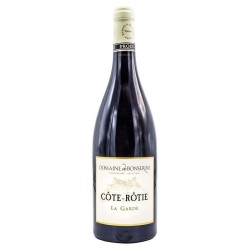
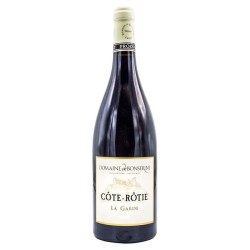
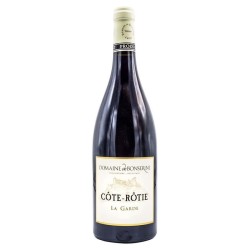
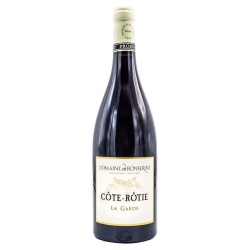
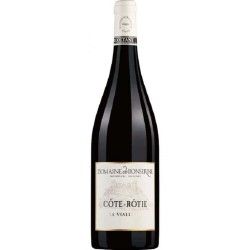
List of products by brand DOMAINE DE BONSERINE
Domaine de Bonserine stands among the most serious producers in Côte-Rôtie. Its 12 hectares of iron-rich, micaceous schist, draped across the terraced hillsides of Ampuis, yield reds of real depth and precision — wines that speak clearly of one of the Vallée du Rhône's most celebrated appellations.
Rooted in the history of Côte-Rôtie
The estate was founded in 1961, at a time when Côte-Rôtie remained little known beyond the Rhône valley itself. Over the following decades, Domaine de Bonserine quietly built a reputation on the strength of its terroir and the care taken in the vineyard. In March 2006, the estate was acquired by the Établissements Guigal — the Guigal family whose name is inseparable from the modern story of the northern Rhône. Crucially, the takeover brought resources and expertise without sacrificing identity: Domaine de Bonserine continues to operate with complete managerial autonomy, under the stewardship of Ludovic Richard. It is this combination — the backing of one of the region's great names alongside the independence of a focused estate — that gives Bonserine its particular character.
Terroir: schist, slope, and two celebrated côtes
The 12 hectares are spread across the two great slopes that define the appellation: the Côte-Blonde, with its lighter, more granitic soils, and the Côte-Brune, whose darker, iron-rich schists produce wines of greater structure and longevity. The terraces — steep, narrow, and impossible to work by machine — demand entirely manual viticulture. The soils are schistes feuilletés, layered schist rich in iron and mica, which drain freely, warm rapidly, and impart a mineral tension that runs through every wine produced here. Exposures are predominantly south-facing, maximising ripeness in a climate that, despite its continental influences, can be unforgiving in cooler vintages.
Grape varieties and winemaking
Syrah — referred to locally as Serine, a biotype long established on these slopes — is the dominant variety, producing reds of aromatic complexity and firm but refined tannins. A small proportion of Viognier is also cultivated and may be co-fermented with Syrah in certain cuvées, a traditional practice in Côte-Rôtie that adds floral lift and textural richness. The estate also produces a white wine. Élevage is conducted with the same attention to detail that characterises the viticulture: the aim throughout is precision and expression of place rather than the imposition of a winemaking style.
The wine range at Domaine de Bonserine
- Côte-Rôtie Rouge — Syrah (Serine), occasionally with Viognier; the backbone of the range, structured and aromatic, with the mineral signature of Ampuis schist.
- La Sarrasine — the estate's flagship red cuvée, awarded three stars in the 2025 Guide Hachette; a wine of considerable depth and ageing potential.
- Côte-Rôtie Blanc — produced from Viognier; a rarer expression of the appellation, floral and textured.
Why we have selected Domaine de Bonserine
At Halles Quercamps, we have been listing Domaine de Bonserine because it represents exactly what we look for in a northern Rhône estate: a clearly defined terroir, rigorous viticulture on some of the steepest parcels in the appellation, and a winemaking approach that lets Côte-Rôtie speak for itself. The Guigal family's involvement provides long-term stability without homogenising the estate's voice — Ludovic Richard's management ensures that Bonserine remains its own thing. The three-star recognition from the 2025 Guide Hachette for La Sarrasine confirms what we have observed across successive vintages. We recommend these wines to enthusiasts building a cellar around the great appellations of the Rhône, and to those who appreciate Syrah at its most precise and terroir-driven. At table, these reds are well suited to roast lamb, game birds, or a well-aged hard cheese.
Explore the wines of Domaine de Bonserine
Browse our full selection of wines from this estate in the listing below, and find the vintage that suits your cellar or your next occasion.