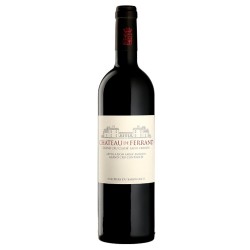
List of products by brand CHÂTEAU DE FERRAND
Château de Ferrand represents one of the most remarkable continuities in Saint-Émilion: founded in 1702, it has passed through the hands of only two families in more than three centuries. That rare stability has allowed a terroir identity to be built slowly and deliberately, vintage by vintage.
A plateau terroir in Saint-Hippolyte
The château sits on the commune of Saint-Hippolyte, to the east of the Saint-Émilion appellation, on a plateau at roughly 100 metres of altitude. The soils here are a distinctive combination of red clays over astéries limestone — the argilo-calcareous plateau that geologists and growers alike regard as one of the defining substrates of the appellation's eastern sector. The natural slope of the land encourages drainage, while the elevation provides good air circulation, reducing disease pressure and contributing to the freshness that characterises the wines. Across 32 hectares, the vineyard is planted predominantly with Merlot (70%), complemented by Cabernet Franc (29%) and a small proportion of Cabernet Sauvignon (1%). This encépagement is well suited to the clay-rich soils, which temper the ripening of Merlot and lend structure and aromatic lift to the Cabernet Franc.
Three centuries of history, two families
Château de Ferrand was founded in 1702 by Élie de Bétoulaud. For the better part of three centuries, the estate remained in remarkably few hands — a continuity that is genuinely unusual in Bordeaux, where properties have often changed ownership repeatedly. In 1977, the château was acquired by Baron Marcel Bich, the industrialist and founder of the BIC group, who brought both investment and long-term vision to the property. Following his death, the estate passed to his heirs, with Pauline Bich Chandon-Moët and Philippe Chandon-Moët taking the lead from 2005 onwards. Their commitment to quality bore formal recognition in 2012, when Château de Ferrand was elevated to Grand Cru Classé status in the Saint-Émilion classification — a distinction that reflects sustained improvement in both viticulture and winemaking over the preceding years.
Organic certification and responsible viticulture
The estate holds three environmental certifications: Agriculture Biologique (certified organic), HVE (High Environmental Value, level III), and Terra Vitis. These are not merely labels: they reflect a genuine commitment to working with the natural balance of the plateau terroir, reducing chemical inputs, and preserving the long-term health of the soils that give the wines their character. For a Grand Cru Classé of Saint-Émilion to pursue full organic certification is a meaningful statement of intent.
The wines of Château de Ferrand
The château produces exclusively red wines under the Saint-Émilion Grand Cru Classé appellation. The range reflects the estate's terroir-driven approach:
- Château de Ferrand Grand Cru Classé — the grand vin, expressing the full depth of the argilo-calcareous plateau: generous Merlot fruit, the spice and structure of Cabernet Franc, and the mineral tension that the astéries limestone imparts.
- Second wine — a more accessible expression of the same terroir, offering the characteristic profile of Saint-Émilion at an earlier stage of its development.
Both wines are produced from the 32-hectare certified organic vineyard in Saint-Hippolyte, with the same rigour applied across the entire property.
Why we have selected Château de Ferrand
At Halles Quercamps, we have listed Château de Ferrand for three reasons that matter to us as merchants. First, the integrity of its organic conversion: in an appellation where reputation can sustain a business regardless of farming choices, the decision to pursue full certification is a genuine commitment. Second, the coherence of the terroir: the plateau of Saint-Hippolyte is a well-defined and distinctive site, and the wines reflect it honestly. Third, the trajectory since 2005: the Bich Chandon-Moët family has invested consistently, and the 2012 Grand Cru Classé elevation was earned rather than inherited.
We recommend these wines to enthusiasts who appreciate Saint-Émilion with genuine structure and ageing potential — bottles suited to the cellar as much as the table. At the table, they pair naturally with roast lamb, duck confit, or a well-aged hard cheese. A considered choice for the cellar, or a gift for someone who takes Bordeaux seriously.
Explore the wines of Château de Ferrand
Browse the full selection from this Grand Cru Classé Saint-Émilion château — all available vintages and cuvées are listed below.