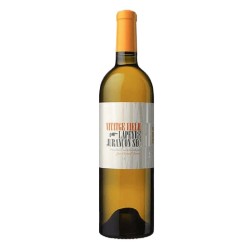
List of products by brand CLOS LAPEYRE
Clos Lapeyre represents Jurançon at its most precise: biodynamically farmed vines on the calcaire poudingues of La Chapelle-de-Rousse, facing the Pyrenees, tended by a family that has worked this terroir without interruption since 1920.
A family estate rooted in the Jurançon hillsides
It was Jean Larrieu who purchased the estate in 1920, establishing what would become a defining family venture on the coteaux of La Chapelle-de-Rousse, one of the most prized communes within the Jurançon appellation. The estate remained in family hands across the generations, and in 1985 Jean-Bernard Larrieu — grandson of the founder and the third generation to tend these vines — took over the reins. His arrival marked a turning point: a deepening commitment to quality, to the expression of terroir, and ultimately to a wholesale rethinking of how the land should be farmed.
Today, Clos Lapeyre extends across 18 hectares of south, south-east, and south-west facing slopes, orientated directly towards the Pyrenees. This exceptional exposure, combined with the altitude and the cooling influence of the mountains, gives the wines their characteristic freshness and tension — qualities that set the finest Jurançon apart from warmer-climate whites.
Terroir: poudingue, clay, and the Pyrenean backdrop
The soils at Clos Lapeyre are a defining feature of the estate. The dominant poudingue calcaire de Jurançon — a conglomerate of rounded pebbles bound in a calcareous matrix — imparts a mineral backbone and fine-grained texture to the wines. Alongside the poudingue, the estate also works parcels of clay, silt, and sandy soils, each contributing different dimensions to the final blends. Petit Manseng, Gros Manseng, Courbu, and the rare Camaralet are the four varieties cultivated here, all indigenous to the Pyrénées-Atlantiques and perfectly adapted to these hillside conditions.
From organic farming to biodynamics: a considered conversion
Jean-Bernard Larrieu's commitment to sustainable viticulture was not a sudden decision but a gradual, reasoned evolution. The estate received organic certification in 2005, eliminating synthetic inputs and restoring the natural balance of the vineyard ecosystem. Between 2013 and 2014, the estate went further, converting fully to biodynamic farming — working with lunar and cosmic cycles, applying biodynamic preparations, and treating the vineyard as a living, self-regulating organism. Both certifications are now in place, and the results are visible in the vitality of the vines and the clarity of the wines.
The wines of Clos Lapeyre
Clos Lapeyre produces exclusively white wines under the Jurançon appellation, in two principal styles:
- Jurançon Sec — dry whites driven by Gros Manseng and Courbu, with the freshness and mineral precision characteristic of the La Chapelle-de-Rousse coteaux.
- Jurançon (moelleux) — sweet whites from Petit Manseng, harvested late by successive tries, with the concentrated citrus, spice, and honeyed depth that define great Jurançon moelleux.
Across both styles, the biodynamic approach and the poudingue terroir lend a consistent thread of mineral tension and aromatic focus that sets Clos Lapeyre apart within the appellation.
Why we have selected Clos Lapeyre
At Halles Quercamps, we have been listing Clos Lapeyre because Jean-Bernard Larrieu's work embodies precisely the kind of rigorous, terroir-driven viticulture we look for in a Sud-Ouest estate. Three reasons stand out. First, the biodynamic certification is genuine and long-established — not a marketing gesture but the result of a decade-long commitment that began with organic conversion in 2005. Second, the poudingue terroir of La Chapelle-de-Rousse is one of the most distinctive in the Jurançon appellation, and the estate works it with real precision. Third, the range spans both dry and moelleux styles, offering our customers a complete portrait of what Jurançon can achieve.
We recommend these wines to enthusiasts who appreciate indigenous varieties and mountain-influenced terroirs, and to those building a cellar with an eye for the Sud-Ouest beyond Bordeaux. At the table, the dry Jurançon is a natural partner for grilled fish, goat's cheese, or asparagus; the moelleux is superb alongside foie gras or a ripe blue cheese.
Discover all wines from this estate
Browse the full selection of Clos Lapeyre wines — dry and moelleux Jurançon — available to order below.