- Out-of-Stock
To your home directly - Taxes 'll be calculated automaticaly after validation of your cart
Free of charge, from Tuesday to Saturday 9:00 AM to 12:15 and 14:00 to 19 PM

Nicolas françois, propriétaire passionné des halles de quercamps
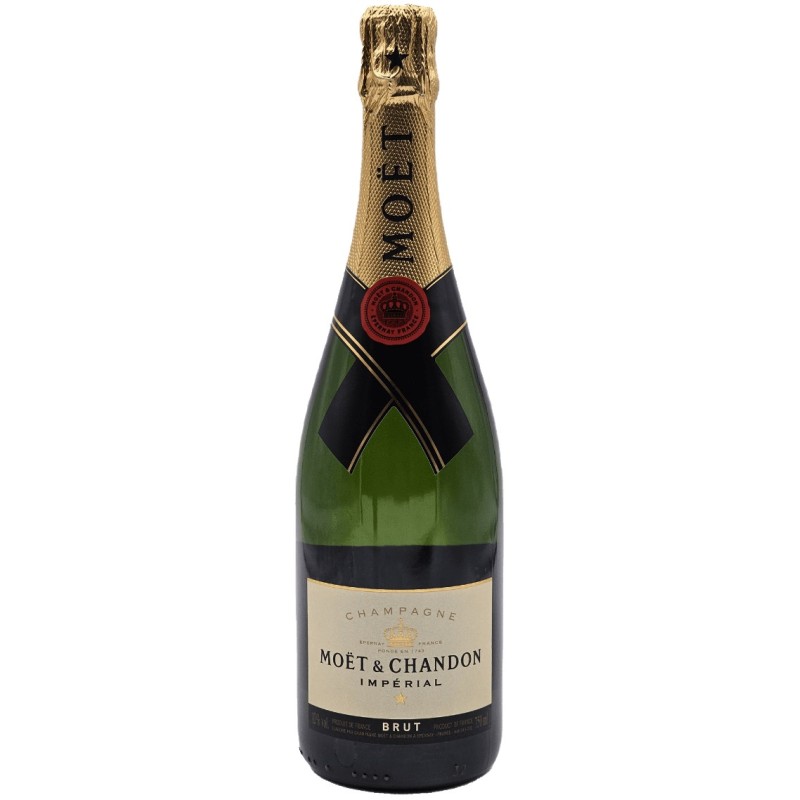
CHAMPAGNE MOET & CHANDON
Founded in Épernay in 1743, Moët & Chandon stands as one of the defining names in the history of Champagne. As the appellation's largest négociant-manipulant, the House commands a vineyard of 1,190 hectares and 28 kilometres of cellars carved into the chalk beneath the city — a combination of scale and heritage that remains without parallel in the region.
Claude Moët established the House in 1743 on the banks of the Marne in Épernay, at a time when Champagne was already establishing itself as the wine of courts and celebrations across Europe. The business grew steadily through the eighteenth century, and in 1833 — following the partnership with Pierre-Gabriel Chandon de Briailles — the House took the name it carries today: Moët & Chandon. Over the following decades it became the dominant force in Champagne commerce, exporting to markets across the globe and cementing Épernay's reputation as the capital of the appellation. Today the House operates within the LVMH group, under the société MHCS, though its winemaking identity and its address on the Avenue de Champagne remain unchanged.
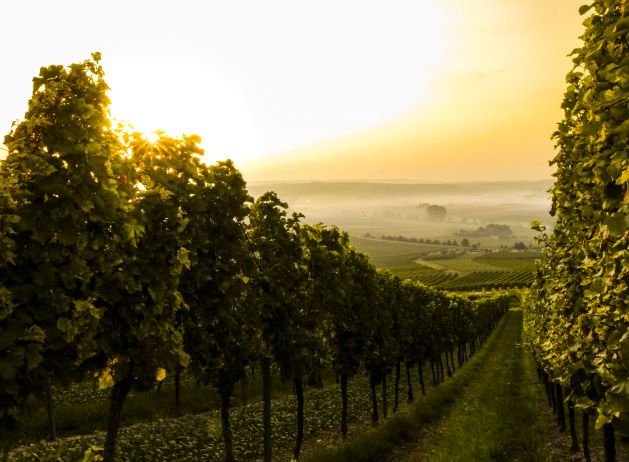
With 1,190 hectares under vine, Moët & Chandon draws fruit from across the full breadth of the Champagne appellation: the Montagne de Reims, the Côte des Blancs, the Vallée de la Marne, and the more southerly zones of Sézanne and the Aube. Soils throughout are predominantly limestone and chalk — the crétaceous formations that give Champagne its characteristic mineral tension and its capacity for long ageing. This diversity of exposure and terroir is precisely what allows the House to maintain the consistency of its assemblages year after year, drawing on reserves and blending across zones with a precision that smaller producers cannot replicate. The three classic Champagne varieties — Pinot Noir, Pinot Meunier, and Chardonnay — are all cultivated across the estate's holdings, giving the winemaking team the full palette of the appellation to work with.
Beneath the streets of Épernay, the House's 28 kilometres of chalk cellars — classified as a monument historique — provide the ideal conditions for the slow, even maturation that quality Champagne demands: constant temperature, darkness, and the natural humidity of the chalk. The House holds HVE certification (Haute Valeur Environnementale), reflecting a commitment to more responsible viticulture across its extensive vineyard holdings. For a producer operating at this scale, that certification carries genuine weight.
At Halles Quercamps, we list Moët & Chandon for reasons that go beyond its renown. The House offers something genuinely valuable to the serious Champagne buyer: stylistic reliability at scale. When you open a bottle from this House, you know what to expect — and that consistency, achieved across 1,190 hectares and millions of bottles, is a genuine technical feat. We also value the breadth of the range: from the approachable non-vintage Brut to the age-worthy vintage releases, there is a Moët & Chandon for every occasion in a well-stocked cellar. This is a House we recommend to confirmed amateurs who want a dependable Champagne reference, as well as to those building a cellar with gifting in mind. At table, these Champagnes pair naturally with shellfish and fine charcuterie, though the vintage expressions hold their own alongside more substantial dishes — roast poultry, aged hard cheeses, or a well-rested turbot.
Browse our full selection of Moët & Chandon Champagnes — sparkling and rosé, non-vintage and vintage — using the filters below.


BRUT WHITE CHAMPAGNE